
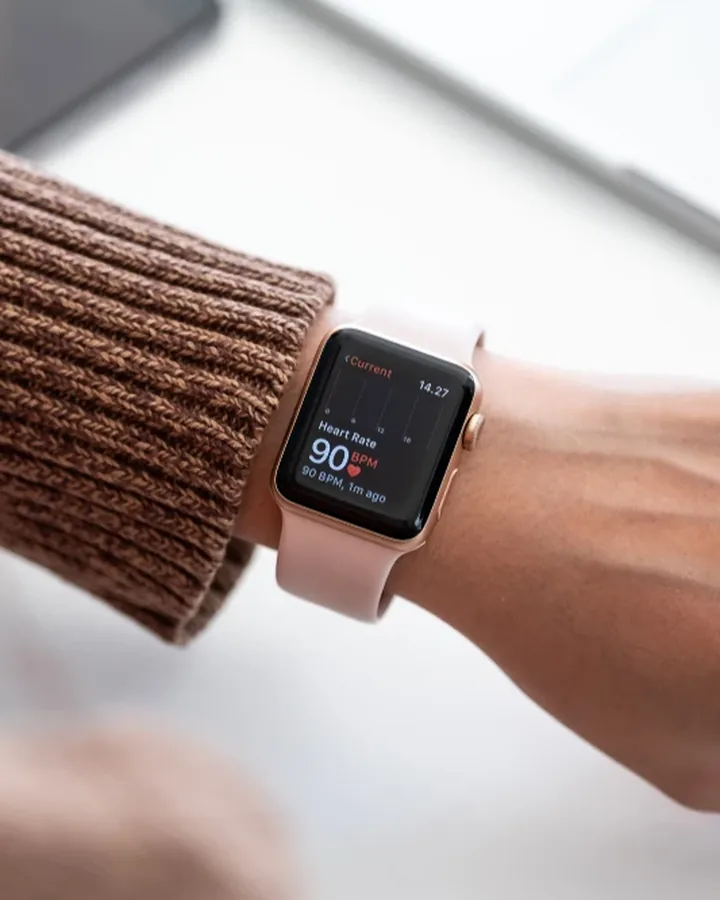
Heart rate variability, usually shortened to HRV, is the slight change in the amount of time between one heartbeat and the next. A healthy heart does not beat like a metronome. The spacing between beats shifts from moment to moment, and that shifting reflects how your nervous system is balancing activity and recovery.
HRV has become one of the most prominent numbers on smartwatch and ring dashboards. Used well, it gives you a useful window into recovery, sleep, and stress. This guide explains what HRV reflects, where it carries real clinical meaning, what shapes your number, and how to read your wearable in a way that leads to better decisions about your health.
What HRV Measures
Your autonomic nervous system controls the functions that happen without conscious effort, including your heart rate. It has two branches. The sympathetic branch prepares your body for action, the familiar fight-or-flight response. The parasympathetic branch supports rest, digestion, and recovery. HRV reflects the interplay between the two.
In general, higher HRV at rest suggests your body is well recovered and able to adapt. Lower HRV suggests your body is under strain from stress, poor sleep, illness, or hard training. Most wearables report a measure called RMSSD, a calculation based on the differences between consecutive heartbeats. Researchers describe RMSSD as the main measure of how strongly the rest-and-recover branch is influencing your heart from one beat to the next, which is why it has become the standard number on consumer devices.
Why HRV Has Clinical Meaning
HRV is more than a fitness metric. In the Framingham Heart Study, researchers examined reduced heart rate variability and mortality risk in an older cohort, and later its link to cardiac events. Those studies, published in Circulation in 1994 and 1996, helped establish HRV as a marker associated with long-term cardiovascular health. Since then, lower HRV has been linked in research to a range of conditions that affect the heart and metabolism.
That research describes patterns across large groups of people. For you as an individual, HRV is most useful as one marker among several, read alongside blood pressure, resting heart rate, fitness, labs, and your history. On its own, a single number says little. In context, a trend can say a great deal.
What Shapes Your HRV
HRV varies widely from person to person, even among healthy people of the same age, and several everyday factors move it up or down. Age is the first: HRV declines gradually over the years. Sleep is the second, and often the most visible. A short or restless night tends to lower HRV the next morning. Alcohol has a strong effect as well. In a study of more than 4,000 employees published in JMIR Mental Health, alcohol intake was linked to lower overnight recovery in a dose-dependent way, meaning the effect grew with the amount consumed.
Fitness pushes HRV in the other direction. Regular aerobic exercise tends to raise it over time, which reflects improved cardiovascular fitness. Psychological stress, anxiety, and depression are associated with lower HRV, and a higher body mass index is associated with lower HRV too. Breathing matters in the short term: slow, deep breathing increases the breathing-linked swing in heart rate, which is why a few minutes of paced breathing can shift your reading. Our page on stress, burnout, and mood explains how we approach the stress side of this picture.
How to Read the Number on Your Wearable
Your HRV reading is most meaningful when you compare it with your own baseline. A reading that is lower than usual for several days in a row tells you more than a single low night. For example, if your overnight HRV usually sits around 45 milliseconds, one night at 35 after a late dinner is not a concern on its own. A full week of readings in the low 30s is a pattern worth noticing. Consistency matters as well. Overnight readings and quick daytime spot checks are measured under different conditions, so they are best tracked separately.
Accuracy varies by device. In a 2022 study published in Sensors, researchers compared six consumer devices against an ECG during overnight sleep in 53 healthy adults. All six underestimated HRV to some degree, and agreement with the ECG ranged from excellent for some devices to poor for others. Your wearable is a good tool for spotting your own trends. It is less reliable as an exact measurement to compare with another person's number or another brand's device.
READ: What Does My Apple Watch or Oura Ring Actually Tell My Doctor?
Building a Reliable Personal Baseline
Because HRV varies so much between individuals, your most useful number is your own baseline, and building one takes a few weeks of consistent tracking. Wear your device the same way every night, on the same wrist or finger. Use the overnight reading, or a morning reading taken at the same time each day in the same position. Track for at least two to four weeks before drawing conclusions, and make a quick note of unusual days, such as travel, illness, a late dinner, alcohol, or an especially hard workout. Then focus on the weekly average and its direction over time.
Once your baseline is in place, a meaningful change stands out clearly. A steady rise over a few months often reflects better sleep or improved fitness. A drop that lasts a week or more is a prompt to look at what has changed in your routine or your health.
HRV and Sleep
Sleep and HRV are closely connected. Much of your body's recovery happens during sleep, and the parasympathetic branch of the nervous system is especially active during the deeper stages. That is why many wearables report HRV from overnight data.
A short night, a late meal, alcohol close to bedtime, or a warm bedroom can all show up as lower HRV the next morning. Regular sleep and wake times, a cool and dark bedroom, and a gap of a few hours between your last meal or drink and bedtime all tend to support better overnight recovery. When your number moves, sleep is usually the first place to look. Our sleep, insomnia, and sleep apnea page covers how we evaluate sleep problems that do not improve with simple changes.
HRV and Exercise Training
Athletes and active adults often use HRV to guide training. A higher than usual reading suggests your body has recovered well and can handle a harder session. A lower than usual reading suggests a lighter day may be wiser. Over months, consistent aerobic training tends to raise your resting HRV.
This approach works best as one input alongside how you feel, your resting heart rate, and your sleep. For golfers, tennis players, and walkers in Naples, the same principle applies on a smaller scale. A run of low readings is a good reason to ease off and recover before pushing harder, and a steady upward trend is a welcome sign that your training is paying off.
How HRV Fits With Your Other Wearable Metrics
HRV is most informative when you read it together with the other numbers your wearable reports. Resting heart rate often moves in the opposite direction: when your body is under strain, resting heart rate tends to rise as HRV falls. Sleep duration and timing explain many day-to-day changes. Some devices also report breathing rate or skin temperature overnight, and a change in these alongside a drop in HRV can be an early sign that you are coming down with something. Looking at these signals together gives you a clearer picture than any single number.
When an HRV Change Is Worth Discussing
A sustained drop in HRV is a signal to look at the bigger picture. Often the explanation is close at hand: a stretch of short sleep, a demanding week at work, more alcohol than usual, or a cold coming on. A drop that persists without an obvious reason is worth raising with your physician, especially when it comes with fatigue, a change in resting heart rate, palpitations, or poor sleep. Your physician can use these trends to decide which questions to ask next and which tests, if any, would help answer them.
An irregular heartbeat, or a wearable alert about your heart rhythm, deserves prompt attention in its own right, separate from HRV trends. Please contact your physician about any rhythm alert.
Common Myths About HRV
A few ideas about HRV circulate widely and can cause confusion. The first is that a higher number is always better. In general, higher resting HRV reflects good recovery, and an unusually high or erratic reading can sometimes appear during illness or with certain heart rhythm changes, so context still matters. The second is that HRV can be compared across devices or across people. Devices measure it at different times and calculate it in slightly different ways, so comparisons work only within one person on one device. The third is that HRV can diagnose a medical condition. It is a useful signal of nervous system balance, and it works best as a prompt for a conversation with your physician, who can decide whether further evaluation is needed.
Habits That Support Healthy HRV
The habits that support a healthy HRV are the same ones that support your long-term health. Consistent sleep and wake times support steady overnight recovery. Regular aerobic exercise, such as walking, cycling, or swimming, tends to raise HRV over time. Keeping alcohol moderate is linked to better overnight recovery. Time outdoors, social connection, and relaxation practices support the parasympathetic system, and a few minutes of slow, steady breathing can help you relax and raise HRV in the short term. Good control of blood pressure, blood sugar, and weight supports the long-term cardiovascular health that HRV partly reflects.
How Naples Concierge Health Uses Wearable Data
Physicians Dr. Jonathan Marsh and Dr. Danielle Grossman-Stuart review wearable data as part of a broader longevity and performance evaluation. Your HRV trends are read alongside sleep, fitness testing, blood pressure, and labs, so each number is placed in context. Our metabolic and VO2 max testing gives a measured view of fitness to compare with what your wearable reports, and you can share a concerning trend with your physician directly between visits. If you are already tracking your health closely, our page for proactive optimizers explains how we work with that data.
Want Your Wearable Data Read in Context?
To have your HRV and other wearable data reviewed as part of a complete health picture, book a gap assessment with Naples Concierge Health. You can also browse everything Naples Concierge Health offers to see the fuller picture first.
Frequently Asked Questions
What is a good HRV number?
There is no single good number. HRV varies widely between healthy people and declines with age, so the most useful comparison is against your own baseline over time.
Is HRV a good health metric?
It is a useful one when read in context. HRV reflects nervous system balance and recovery, and lower HRV has been associated with cardiovascular risk in research. It works best alongside resting heart rate, blood pressure, fitness, and labs.
Are smartwatch and ring HRV readings accurate?
Accuracy varies by device and by how the measurement is taken. Studies comparing consumer devices with an ECG have found that many underestimate HRV. They are better suited to tracking your own trend over time than to exact measurement.
How long does it take to establish an HRV baseline?
Most people need two to four weeks of consistent tracking, using the same device and the same measurement time each day. A weekly average gives a steadier picture than any single reading.
Why is my HRV lower after drinking alcohol?
Alcohol shifts the nervous system toward a more activated state during sleep, which reduces overnight recovery. Research has found this effect grows with the amount consumed.
Can I improve my HRV?
Often, yes. Consistent sleep, regular aerobic exercise, limiting alcohol, and managing stress all tend to support higher HRV over time. Slow breathing exercises can also raise it in the short term.
When should I talk to a physician about my HRV?
Raise it when a drop persists for more than a few days without a clear explanation, or when it comes with fatigue, palpitations, or poor sleep. Any wearable alert about an irregular heart rhythm should be discussed promptly.
Does HRV change when I am getting sick?
It can. Illness is one of the common reasons HRV drops, and a lower reading often appears alongside a higher resting heart rate. A change like this is a good reason to rest, and to contact your physician if symptoms develop or persist.
Should I compare my HRV with friends or family?
That comparison tells you little. HRV differs widely between individuals, and devices calculate it in slightly different ways. Tracking your own trend on the same device is far more informative.
You might also be interested in reading: