
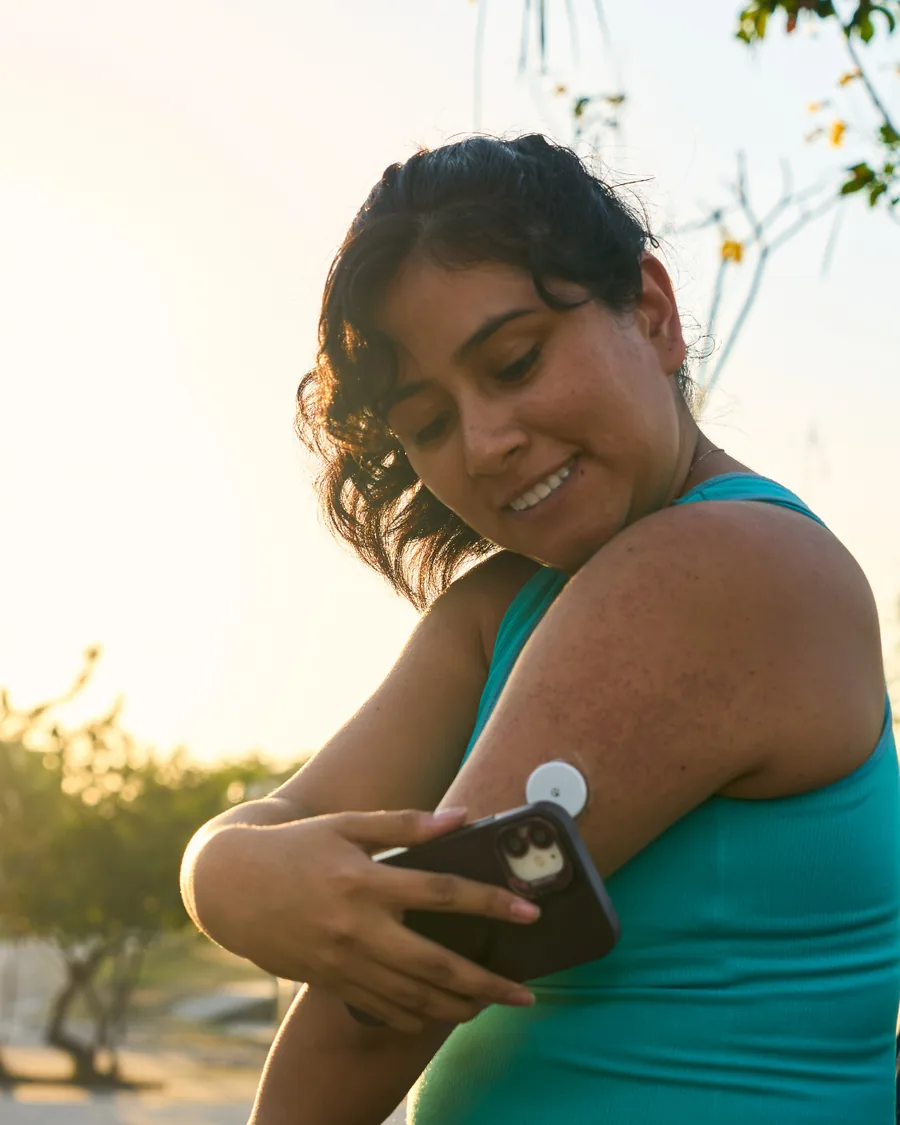
Continuous glucose monitors have moved well beyond diabetes care. Health-conscious patients now wear them to see how food, sleep, and exercise interact with a metabolism that has never shown a sign of a blood sugar problem. A sensor on the arm and a smooth line on a phone screen turn every meal into a data point. Some of that data is genuinely useful and worth acting on. Some of it is a normal metabolic process getting flagged as a problem it never was. This guide covers what a continuous glucose monitor measures, what the research shows about wearing one without diabetes or prediabetes, and how to tell a meaningful signal from noise.
What a Continuous Glucose Monitor Measures
A continuous glucose monitor, or CGM, is a small sensor worn on the back of the arm or the abdomen that measures glucose in the fluid directly beneath the skin every few minutes. The device pairs with an app that turns those readings into a graph, showing glucose rising and falling across the day in response to meals, workouts, stress, and sleep. CGMs were developed and validated for people managing diabetes, where seeing glucose trends in real time helps guide insulin dosing and catch dangerous highs or lows before they become an emergency. The technology has since become available over the counter and through wellness programs for people without diabetes. That availability is a large part of what has driven healthy adults to start wearing one out of curiosity or for performance tracking.
What Does a Normal Glucose Pattern Look Like Without Diabetes?
A 2019 study in the Journal of Clinical Endocrinology and Metabolism gives a clear picture of what CGM data looks like in people who do not have diabetes. Researchers led by Shah and colleagues fitted 153 healthy participants, ranging from age seven to eighty, with CGMs for up to ten days and tracked their glucose with no intervention at all. The average reading was 98 to 99 mg/dL in every age group except adults over 60. Glucose stayed within a range of 70 to 140 mg/dL a median of 96 percent of the time. Readings above 140 mg/dL occurred a median of 2.1 percent of the time, and readings below 70 mg/dL 1.1 percent of the time. Glycemic variability, a measure of how much glucose swings up and down, averaged 17 percent: a tight, stable band for a system running with no outside management.
The same study found that adults over 60 ran modestly higher, with an average glucose of 104 mg/dL. That difference is a reminder that some drift in glucose control is a normal part of aging, not a diagnosis on its own. The larger point holds across age groups: a healthy, non-diabetic metabolism already keeps glucose inside a narrow range for nearly the entire day, without a monitor, a coach, or an app telling it to.
Is There Evidence a CGM Helps a Healthy Person?
The evidence is thin, and most of what exists describes what CGM data looks like in healthy people rather than proving that wearing one changes health outcomes for someone without diabetes or prediabetes. Continuous glucose monitoring has a well-established record in diabetes management, where it reduces dangerous highs and lows and improves long-term blood sugar control. That evidence does not automatically carry over to a healthy population. There is not yet a body of research showing that healthy adults who track their glucose out of general interest see a measurable improvement in weight, energy, or long-term metabolic health. The research that does exist, including the Shah study above, mostly describes what normal glucose patterns look like rather than testing whether watching those patterns changes behavior or outcomes for the better.
That gap matters because most consumer CGM apps are not calibrated with a healthy baseline in mind. A number of them flag any reading above 140 mg/dL as a spike worth attention. Healthy, non-diabetic volunteers in the Shah study crossed that same threshold a median of 2.1 percent of the time, and briefly higher right after a typical meal. A temporary rise after eating is an ordinary digestive response for someone with no diabetes risk factors, not a warning sign. Reading that rise as a problem is where a lot of the anxiety around at-home glucose tracking comes from.
When Wearing a CGM Might Be Worth It
For a specific slice of healthy patients, a CGM can add real information to a health picture. Whether a healthy person should wear a CGM tends to come down to whether there is a clear question it is meant to answer, not general curiosity alone.
- A family history of type 2 diabetes or prediabetes, where seeing how specific foods and habits affect glucose can flag a pattern worth discussing with a physician early.
- A personal history of gestational diabetes or borderline lab results, since glucose trends can shift years before a fasting test or A1C reflects it.
- Structured athletic or performance training, where fueling and recovery decisions benefit from glucose data read alongside other performance metrics.
- An active metabolic health goal already being managed with a physician, where a CGM adds a layer of feedback inside a broader health optimization plan rather than standing alone.
When It Is More Noise Than Signal
For a healthy adult with no family history of diabetes, no metabolic risk factors, and no specific performance goal, a CGM is likely to generate more anxiety than insight. Because a normal metabolism already keeps glucose in range the large majority of the time, as the research above shows, there is often little new information to act on. What shows up instead is a stream of ordinary post-meal fluctuations, relabeled as problems because an app decided to flag them. Watching that stream day after day, without a clear question it is meant to answer or a physician helping interpret it, tends to produce more worry than benefit.
READ: Concierge Medicine in Naples: The Long-Term Health Advantages, Explained
How a Physician Puts Glucose Data to Use
When glucose tracking does make sense, its value comes from context, not from the raw numbers on a phone screen. A physician who already knows a patient’s family history, activity level, and other lab results can review a week of CGM data and tell whether a pattern is worth addressing or is a normal fluctuation. That is exactly what performance medicine and health optimization at Naples Concierge Health are designed to do: take data from a CGM, a VO2 max test, or a body composition scan and turn it into a plan built for that patient, instead of leaving them with a set of numbers to interpret on their own.
Curious Whether Glucose Tracking Fits Your Health Picture?
Naples Concierge Health physicians Dr. Jonathan Marsh and Dr. Danielle Grossman-Stuart help patients decide which proactive health tools are worth their attention, glucose tracking included. Book a gap assessment with Naples Concierge Health to talk through what a personalized approach to metabolic health looks like, or browse everything Naples Concierge Health offers to see the fuller picture first.
You might also be interested in reading:
More from this series:
- How Long Does Perimenopause Last? Symptoms, Timeline, and What Helps
- Why Panel Size Is Important in Concierge Medicine
Frequently Asked Questions
Do healthy people need a continuous glucose monitor?
Most healthy people without diabetes, prediabetes, or a family history of metabolic disease do not need a continuous glucose monitor to stay informed about their health. Research on non-diabetic glucose patterns shows that a normal metabolism already keeps glucose in a narrow, healthy range on its own. A CGM can still be a useful tool for someone with a specific reason to track it, but it is not a required piece of proactive health for everyone.
What counts as a normal blood sugar range without diabetes?
Research on healthy, non-diabetic adults wearing CGMs found an average glucose reading of 98 to 99 mg/dL, with glucose staying between 70 and 140 mg/dL a median of 96 percent of the time. Readings above 140 mg/dL or below 70 mg/dL happened only occasionally and were usually brief.
Can a CGM diagnose prediabetes or diabetes?
A continuous glucose monitor is not a diagnostic tool. Prediabetes and diabetes are diagnosed with standardized blood tests, such as a fasting glucose test, an A1C test, or an oral glucose tolerance test, interpreted by a physician. A CGM can show a pattern worth discussing with a physician, but a formal diagnosis still requires those standard tests.
Are the glucose spikes I see on a CGM something to worry about?
Usually not, for someone without diabetes or a related risk factor. A temporary rise in glucose after a meal is a normal part of digestion. The 2019 study on healthy adults found that people with no metabolic issues crossed the 140 mg/dL threshold many apps label a spike a median of 2.1 percent of the time. A single high reading is rarely meaningful on its own. A physician who knows a patient’s full history is better positioned than an app’s default alert to say whether a pattern is worth addressing.
Who is a CGM most likely to help?
People with a family history of type 2 diabetes, a personal history of gestational diabetes or borderline lab results, and those doing structured athletic or performance training tend to get the most useful information from a CGM. That is especially true when a physician is interpreting the data alongside the rest of their health picture.
This article is for general information and does not constitute medical advice. It does not create a physician-patient relationship. Talk with a physician before starting, stopping, or drawing conclusions from any glucose monitoring on your own.