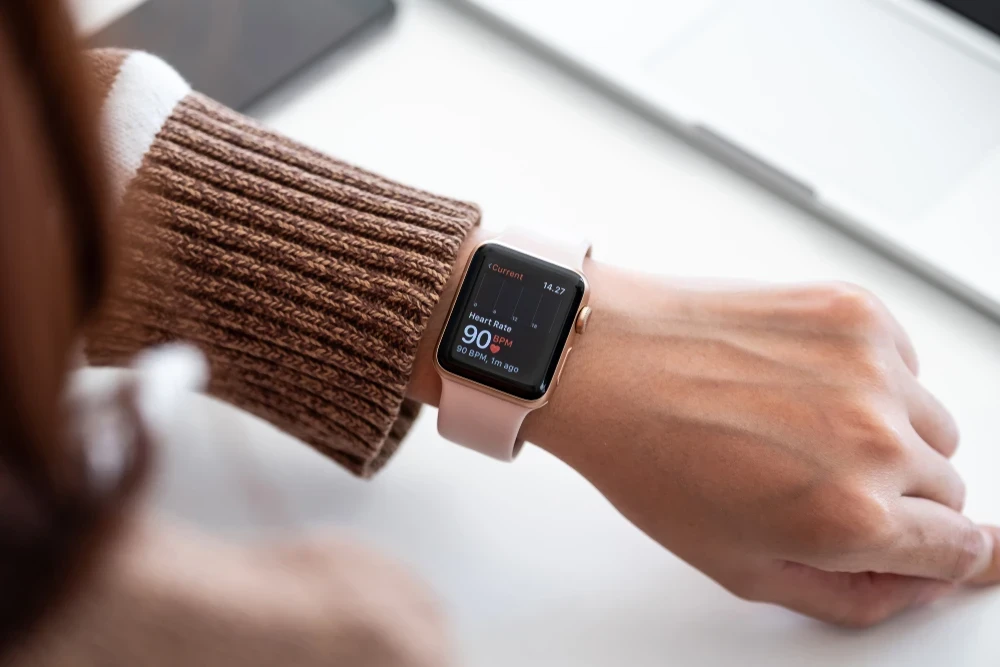
Apple Watch, Oura Ring, WHOOP, and similar devices now collect heart rate, sleep, rhythm, and activity data around the clock. For active adults focused on longevity and prevention, that information can sharpen a medical plan or generate noise—depending entirely on how a physician reviews it. The real value does not simply in owningthe device —it is in understanding which signals matter and how they should guide clinical decisions.
Why These Systems Matter
Wearables do not replace a physical exam, lab panel, ambulatory monitor, or sleep study. What they add is continuous health insight between visits—often allowing subtle changes to appear earlier than they otherwise would.
A steady rise in resting heart rate, repeated rhythm alerts, or consistently fragmented sleep can surface a problem before function declines enough to force a clinical encounter. For adults over 50, that earlier signal supports earlier evaluation and more personalized follow-up.
Know What the Device Measures Accurately—and What It Does Not
Consumer wearables perform well on some metrics and poorly on others. A 2024 umbrella review found that heart rate tracking carries a mean bias of only ±3%, and arrhythmia detection showed pooled sensitivity and specificity of 100% and 95%, respectively. Step counts, by contrast, were underestimated by roughly 9% to 12%, and physical activity intensity estimates had errors ranging from 29% to 80% depending on the activity type. Critically, only about 11% of commercially available devices had been validated for even one biometric outcome (Doherty et al., 2024). A polished app interface does not equal clinical-grade measurement. The physician should review repeated trends over two to four weeks—not a single bad score, a calorie estimate, or one readiness number.
Doctor’s Note: Calorie-burn and proprietary readiness scores are the least reliable outputs consumer wearables produce. Heart rate, step count, sleep duration, and rhythm alerts carry the most clinically actionable signal.
When Rhythm Alerts Should Prompt Medical Review
Wearable rhythm tools have real value, but they work best in a defined lane. The Apple Watch ECG app can generate a single-lead recording and classify atrial fibrillation or sinus rhythm; the Apple Heart Study, enrolling more than 400,000 participants, confirmed irregular pulse notifications identified atrial fibrillation with an 84% positive predictive value at the time of notification (Perez et al., 2019). The ACC advises that Apple Watch is best suited for general wellness, preclinical screening, or monitoring in patients with a known arrhythmia already being managed—and that when real-time clinical alerts are necessary, a continuous ECG monitor remains the stronger option (American College of Cardiology, 2025). Repeated irregular rhythm notifications, palpitations, unexplained lightheadedness, orreduced exercise tolerance should prompt formal medical evaluation rather than self-monitoring alone.
Sleep and Recovery Scores Require Clinical Context
Sleep tracking has more value for duration and regularity than for precise staging. A 2024 validation study of the Oura Ring Gen3 found overall sleep-wake accuracy above 91%, with good agreement against polysomnography for total sleep time and most global sleep measures (Svensson et al., 2024). Despite those results, all major devices still need improvement for precise sleep-stage assignment, and recovery and readiness scores—WHOOP’s, Oura’s, Garmin’s—are built on proprietary algorithms that have not undergone formal clinical validation (Doherty et al., 2024). A sustained dip in sleep quality or recovery may reflect alcohol, travel, illness, medication timing, or training load—but the score itself does not identify the underlying cause. The physician should focus on total sleep time, bedtime regularity, nocturnal heart rate, and sustained changes from the individual’s baseline.
In-Office Review Turns Raw Data Into Decisions
Wearable data becomes useful when the physician places it beside symptoms, medications, blood pressure, laboratory results, and exercise habits. Devices can encourage better habits without fixing the bigger drivers of health on their own. A 2025 systematic review and meta-analysis of 23 randomized controlled trials in community-dwelling older adults found that wearable tracker–based interventions increased physical activity time and daily step counts, but did not significantly improve body composition or physical function (Li et al., 2025). That finding reflects daily clinical reality: a device can improve awareness and adherence, but it cannot replace strength training, nutritional planning, rhythm evaluation, or sleep-disorder testing. In-office review should stay focused on a short set of actionable signals, then move quickly to decisions about testing, training, recovery, or treatment.
What to Do Next
- Bring 14 to 30 days of trend data to every visit: resting heart rate, step count, sleep duration, and nocturnal heart rate. Trend review is more useful than isolated screenshots.
- Prioritize validated metrics. Heart rate, activity time, sleep duration, and rhythm alerts carry reliable signal. Calorie estimates and composite readiness scores carry the least.
- Act on rhythm alerts the same day. Repeated irregular-rhythm notifications, palpitations, chest pressure, or unexplained exercise intolerance are medical issues. Contact the physician promptly.
- Schedule a wearable data review at least every six months—sooner after any new symptom, medication change, illness, or clear decline in performance.
- Investigate two or more weeks of poor sleep or elevated nocturnal heart rate. Review alcohol intake, meal timing, training load, and medications with the physician before accepting a pattern as normal.
- Do not substitute wearable data for guideline screenings. Colonoscopy, mammography, lipid panels, and cardiovascular risk assessment remain essential—wearables supplement them.
Turn Wearable Data Into Meaningful Preventative Care
Wearables strengthen preventive care when they stay in the right lane: surfacing patterns between visits, flagging meaningful change earlier, and adding precision to clinical decisions. They do not replace clinical judgment or formal testing. A concierge physician has the time, continuity, and more comprehensive clinical perspective to identify meaningful trends, filter out unnecessary noise, and build a personalized plan focused on long-term health, performance, and prevention.
Visit www.naplesconciergehealth.com to learn more or make an appointment.
To receive health insights, preventive medicine updates, and news from Naples Concierge Health directly in your inbox, sign up to join the newsletter.
Frequently Asked Questions
1. Can a physician use WHOOP, Oura Ring, or Apple Watch data during a medical appointment?
Yes. Longitudinal data from consumer wearables—particularly resting heart rate trends, sleep duration, step counts, and rhythm alerts—provides clinically useful context when reviewed alongside labs, medications, and medical history. A concierge physician has the time to incorporate these trends into a personalized prevention plan.
2. What should I do if my Apple Watch or Oura Ring shows an irregular heart rhythm?
Contact the physician the same day. Repeated irregular rhythm notifications should trigger formal clinical review—including a 12-lead ECG or medical-grade ambulatory monitoring when indicated. The Apple Watch ECG app is an informational tool, not a diagnosis. The ACC advises that when real-time clinical monitoring is necessary, a continuous ECG monitor is the stronger option.
3. How accurate is wearable sleep tracking?
Wearables are reasonably accurate for estimating total sleep time and detecting sleep versus wake—the Oura Ring Gen3 showed overall accuracy above 91% for sleep-wake detection against polysomnography. All major devices are less reliable for precise sleep stage assignment. Consistently poor sleep scores, frequent nighttime waking, or daytime fatigue despite adequate time in bed should prompt a formal clinical evaluation.
4. Which wearable metrics are most clinically reliable?
Resting heart rate, sleep duration, step count, and rhythm alerts carry the most validated signal. Calorie-burn estimates and proprietary composite scores (readiness, recovery, strain) are the least reliable outputs. A physician reviewing two to four weeks of heart rate and sleep trends alongside full clinical history will extract far more value than a single-day score.
5. What is the benefit of reviewing wearable data with a concierge physician versus reading it myself?
Clinical context is what separates a signal from noise. A concierge physician reviews wearable trends alongside laboratory results, medications, cardiovascular history, and health goals—identifying patterns that require action and distinguishing them from benign variation. A device can improve awareness and daily habits, but it cannot replace a physician-guided prevention plan.
References
- Doherty, C., Baldwin, M., Keogh, A., Caulfield, B., & Argent, R. (2024). Keeping pace with wearables: A living umbrella review of systematic reviews evaluating the accuracy of consumer wearable technologies in health measurement. Sports Medicine, 54, 2907–2926. https://doi.org/10.1007/s40279-024-02077-2
- Li, R., Li, Y., Wang, L., Li, L., Fu, C., Hu, D., & Wei, Q. (2025). Wearable activity tracker–based interventions for physical activity, body composition, and physical function among community-dwelling older adults: Systematic review and meta-analysis of randomized controlled trials. Journal of Medical Internet Research, 27, e59507. https://doi.org/10.2196/59507
- Perez, M. V., Mahaffey, K. W., Hedlin, H., Rumsfeld, J. S., Garcia, A., Ferris, T., Balasubramanian, V., Russo, A. M., Rajmane, A., Cheung, L., Hung, G., Lee, J., Kowey, P., Talati, N., Nag, D., Gummidipundi, S. E., Beatty, A., Hills, M. T., Desai, S., … Turakhia, M. P. (2019). Large-scale assessment of a smartwatch to identify atrial fibrillation. New England Journal of Medicine, 381(20), 1909–1917. https://doi.org/10.1056/NEJMoa1901183
- Svensson, T., Madhawa, K., Nt, H., Chung, U., & Svensson, A. K. (2024). Validity and reliability of the Oura Ring Generation 3 (Gen3) with Oura sleep staging algorithm 2.0 (OSSA 2.0) when compared to multi-night ambulatory polysomnography: A validation study of 96 participants and 421,045 epochs. Sleep Medicine, 115, 251–263. https://doi.org/10.1016/j.sleep.2024.01.020
- American College of Cardiology. (2025, May 20). American College of Cardiology issues guidance on using Apple Watch for heart health monitoring [Press release]. https://www.acc.org/about-acc/press-releases/2025/05/20/18/09/american-college-of-cardiology-issues-guidance-on-using-apple-watch-for-heart-health-monitoring