
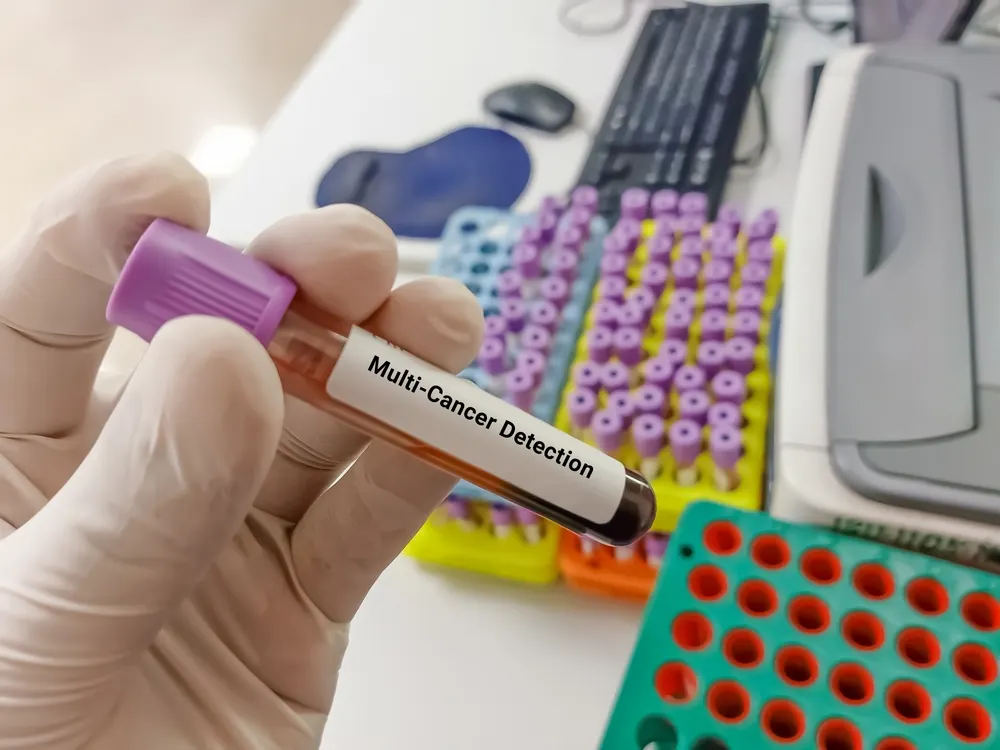
Cancer screening has traditionally focused on one organ at a time—colonoscopy for colon cancer, mammography for breast cancer, and low-dose CT for lung cancer in smokers. The Galleri test represents a different approach: a single blood draw designed to detect signals from more than 50 cancer types simultaneously (GRAIL, Inc., 2021). For adults over 50 who prioritize preventive health, understanding what this test can and cannot do matters for making informed decisions about early detection.
What Matters Most
Galleri analyzes fragments of tumor DNA circulating in the bloodstream, looking for methylation patterns that distinguish cancerous cells from healthy ones (Klein et al., 2021). The test aims to find cancers before symptoms appear, particularly those without routine screening options—pancreatic, ovarian, liver, esophageal, and certain blood cancers. These cancers account for roughly 70% of cancer deaths in the United States, yet standard screening protocols do not address them (Nature, 2024). Early detection remains the strongest predictor of favorable outcomes across nearly all cancer types, making the promise of broader surveillance compelling.
How the Test Performs in Clinical Practice
Galleri detects a cancer signal in 0.93% of screened adults over 50. In the largest study to date—PATHFINDER 2, involving 25,000 participants—the test identified 133 cancers with a positive predictive value of 61.6% (GRAIL, Inc., 2025). This means roughly six out of ten positive results confirmed an actual cancer, a notably high rate compared to many established screening tests. The test’s specificity reached 99.6%, translating to only one false positive per 250 people screened (GRAIL, Inc., 2025).
Sensitivity varies significantly by cancer stage and type. The test detected 40.4% of all cancers that emerged within one year, and 73.7% of the 12 deadliest cancer types (GRAIL, Inc., 2025). For very early Stage I cancers, sensitivity drops to under 20%, meaning most tiny tumors go undetected (Klein et al., 2021). Stage II cancers show roughly 40% detection rates, Stage III around 77%, and Stage IV approaching 90%. The test performs poorly for certain cancers including thyroid, prostate, and some kidney cancers, but shows strength in detecting aggressive cancers that shed more DNA into circulation.
Approximately 75% of cancers found by Galleri have no standard screening available (GRAIL, Inc., 2025). Half of detected cancers were early stage (I or II), creating opportunities for curative intervention before symptoms develop.
What Happens After a Positive Result
When Galleri detects a cancer signal, it predicts the likely organ of origin with 92% accuracy, providing crucial guidance for diagnostic workup (GRAIL, Inc., 2025). Rather than searching blindly, physicians can order targeted imaging and specialist consultations based on the predicted location—pelvic ultrasound for suspected ovarian cancer, CT chest for lung, upper endoscopy for gastrointestinal signals.
The median time from positive result to diagnostic resolution is 46 days (GRAIL, Inc., 2025). Only 0.6% of all screened individuals underwent invasive procedures as a result of testing, indicating that most follow-up investigations rely on imaging and laboratory work before proceeding to biopsy. False positives require additional testing but rarely lead to unnecessary surgery (Schrag et al., 2023).
Limitations Patients Must Understand
A negative Galleri result does not guarantee absence of cancer. The test will miss approximately 60% of cancers present, particularly small, early-stage tumors. Patients cannot rely on this test alone and must continue all recommended age-appropriate screenings—colonoscopy, mammography, cervical cancer screening, and lung CT when indicated.
No randomized controlled trial has yet demonstrated that Galleri reduces cancer mortality. The test detects cancers, but whether earlier detection through this method improves survival outcomes remains under investigation. Long-term outcome studies are ongoing, with results expected over the next several years (Hoffman et al., 2025).
The test costs approximately $950 out-of-pocket and is not currently covered by insurance. It requires a prescription and is not FDA-approved, though approval is under review. Major medical organizations, including the U.S. Preventive Services Task Force and the American Cancer Society, have not endorsed routine use, citing insufficient evidence of net benefit (Hoffman et al., 2025).
What to Do Next
Patients considering Galleri should take the following steps:
Maintain all guideline-recommended screenings regardless of Galleri results—colonoscopy every 10 years (or more frequently based on findings), annual mammography for women, low-dose CT for eligible current or former smokers, and cervical cancer screening per established protocols.
Discuss personal cancer risk factors with the physician, including family history of specific cancers, genetic mutations, environmental exposures, and lifestyle factors that may warrant enhanced surveillance.
Understand that Galleri functions as a supplemental screening tool, not a replacement for proven detection methods or clinical vigilance.
If choosing to proceed with testing, ensure the physician ordering the test can appropriately manage both positive and negative results, including coordinating follow-up diagnostics if a signal is detected.
Recognize that a negative result provides limited reassurance—it means no circulating tumor DNA was detected at that moment, not that cancer is absent.
Consider financial implications, as the test and any follow-up investigations may not be covered by insurance.
Expect to participate in shared decision-making, weighing personal tolerance for uncertainty, anxiety around false positives, and interest in early-stage detection against current limitations in evidence.
What This Means for Your Care
Multi-cancer blood testing represents an emerging frontier in preventive oncology. For patients who value comprehensive surveillance and understand the test’s limitations, Galleri offers an additional layer of screening that may detect aggressive cancers earlier than traditional methods alone (Lennon et al., 2020). The concierge physician can provide personalized guidance based on individual risk profiles, coordinate appropriate follow-up if testing is pursued, and ensure that foundational screening protocols remain in place. As evidence matures, multi-cancer detection tests may eventually become standard practice, but for now, they require careful consideration within the context of proven preventive strategies.
Visit www.naplesconciergehealth.com to learn more or make an appointment.
References
- GRAIL. (n.d.). Our history. GRAIL. https://grail.com/our-history/
- Klein, E. A., et al. (2021). Clinical validation of a targeted methylation-based multi-cancer early detection test using an independent validation set. Annals of Oncology, 32(9), 1167–1177. https://doi.org/10.1016/j.annonc.2021.05.806
- Vittone, J., Gill, D., Goldsmith, A., Klein, E. A., & Karlitz, J. J. (2024). A multi-cancer early detection blood test using machine learning detects early-stage cancers lacking USPSTF-recommended screening. npj Precision Oncology, 8, Article 91. https://doi.org/10.1038/s41698-024-00568-z
- GRAIL, Inc. (2025, October 17). GRAIL PATHFINDER 2 results show Galleri® multi-cancer early detection blood test increased cancer detection more than seven-fold when added to USPSTF A and B recommended screenings. GRAIL. https://www.grail.com/press-releases/grail-pathfinder-2-results-show-galleri-multi-cancer-early-detection-blood-test-increased-cancer-detection-more-than-seven-fold-when-added-to-uspstf-a-and-b-recommended-screenings/
- Schrag, D., Beer, et al. (2023). Blood-based tests for multicancer early detection (PATHFINDER): A prospective cohort study. The Lancet, 402(10409), 1251–1260. https://doi.org/10.1016/S0140-6736(23)01700-2
- Hoffman, R. M., et al. (2025). Multicancer early detection testing: Guidance for primary care discussions with patients. Cancer, 131(7), e35823. https://doi.org/10.1002/cncr.35823